Christmas should be a gentle and joyful time — a moment to slow down and do something kind for one another. And yet, all too often, it turns into a season of unnecessary overconsumption.
My sister and I realised this during one of our conversations. Neither of us needed more things that would end up sitting on a shelf and taking up space — not to mention the CO₂ emissions involved in producing them. We quickly found ourselves developing a simple concept for the kind of Christmas gifts we wanted to give.
Our Christmas gift guidelines became:
- Second-hand
- Experiences
- Homemade gifts
- Charity
- Food & drinks
Over the years, we’ve given each other some truly wonderful gifts within this framework. I’ve received small table lamps from a second-hand shop in Randers. My father once received a large bucket filled with leftover nails and screws — and surprisingly, we were both genuinely delighted. My mother has given me kitchen items that she and my father inherited from their grandparents: special knives and forks with ivory handles for fish, small glasses for dessert wine, and a cake stand.
Books are always popular. There hasn’t been a single Christmas without a book changing hands. One of the best books I’ve ever received was found by my partner: Cities and Buildings by Steen Eiler Rasmussen.
We’ve also given each other experiences — for example, concert tickets to Svaneborg Kardyb, a stay in a summer house in Sweden, and a contemporary dance performance about autumn set to music by the Italian composer Einaudi.
My sister has taken up woodturning, and I often receive a wooden bowl she has made herself. They are truly beautiful, and I know each one represents many hours of careful work — wood is a living material and demands patience and respect. I’ve knitted socks and mittens with old Norwegian patterns for my sister’s partner, which I received many compliments for.
In 2024, I gave away donation certificates. My partner’s daughter and her friends received certificates supporting a children’s home in Bolivia, the Green Youth Movement in Denmark, and the Danish Nature Foundation. One year, when I had to give a gift to someone I didn’t know very well, she received everything I could find on the Save the Orangutan website.
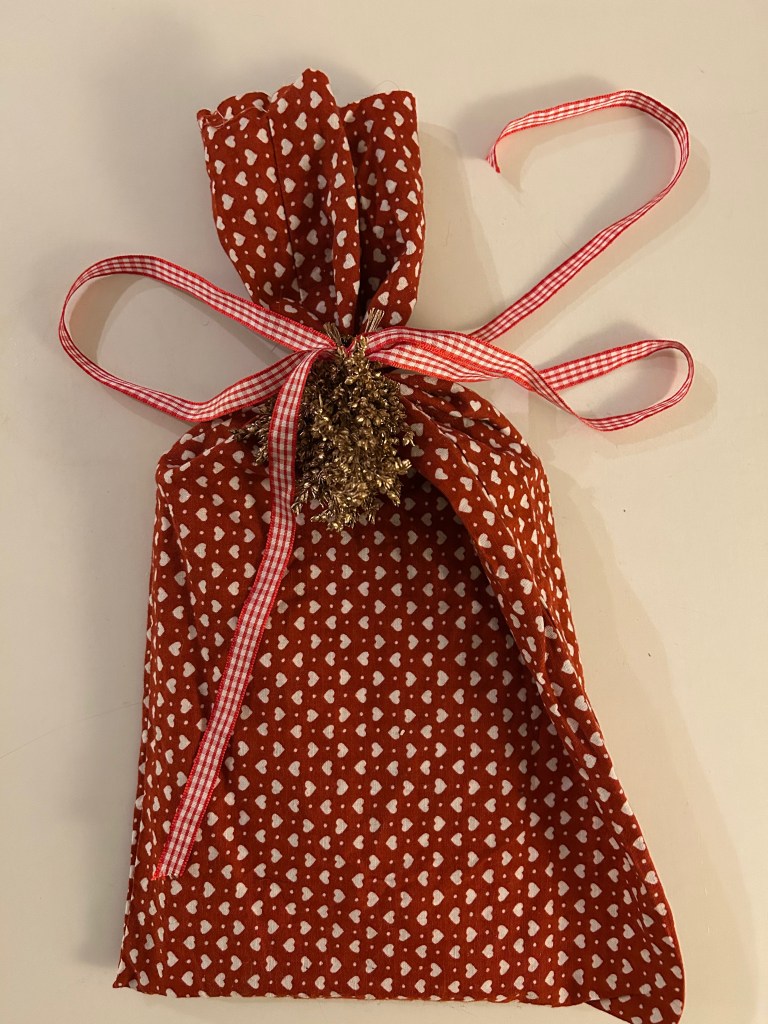
Whenever possible, we wrap our gifts in fabric bags tied with fabric ribbons. When Christmas is over, we wash and iron the bags and ribbons and store them in the attic — ready to be used again next year.
And when imagination fails, there is always food and drinks. My father always receives a specialty beer. Once, I received a basket filled with the most beautiful onions — a gift I still remember with great joy.
I hope this can inspire you, because there is a real need for action. According to Statistics Denmark, each Dane emitted 6.4 tonnes of CO₂ equivalents in 2024 — and this number does not include emissions from goods and consumption. The Danish Council on Climate Change states that Denmark has the second-highest consumption-based climate footprint per capita in the EU, at around 10 tonnes of CO₂e per person. This footprint includes emissions both within and outside Denmark’s borders.
Perhaps it’s time to slow down. Christmas doesn’t need to be bigger to be better. Sometimes, the most generous gift is simply care: for each other, for the planet, and for the future we are shaping together.

 Raw Food Nordic